The Constitution of the United States
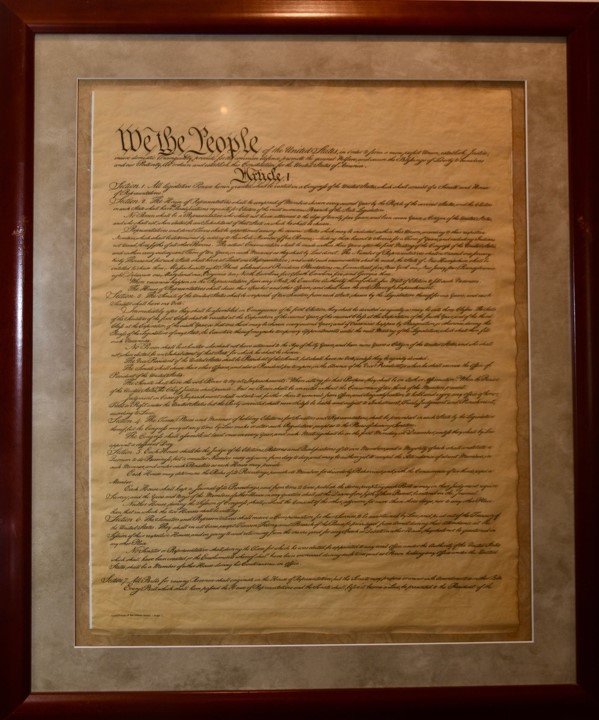
On the wall, in four frames, is a replica of the Constitution of the United States.
Origins of the Constitution
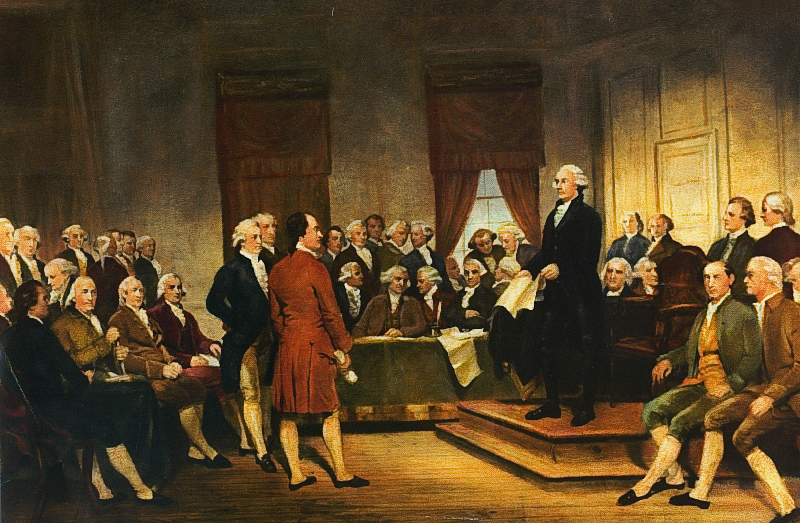
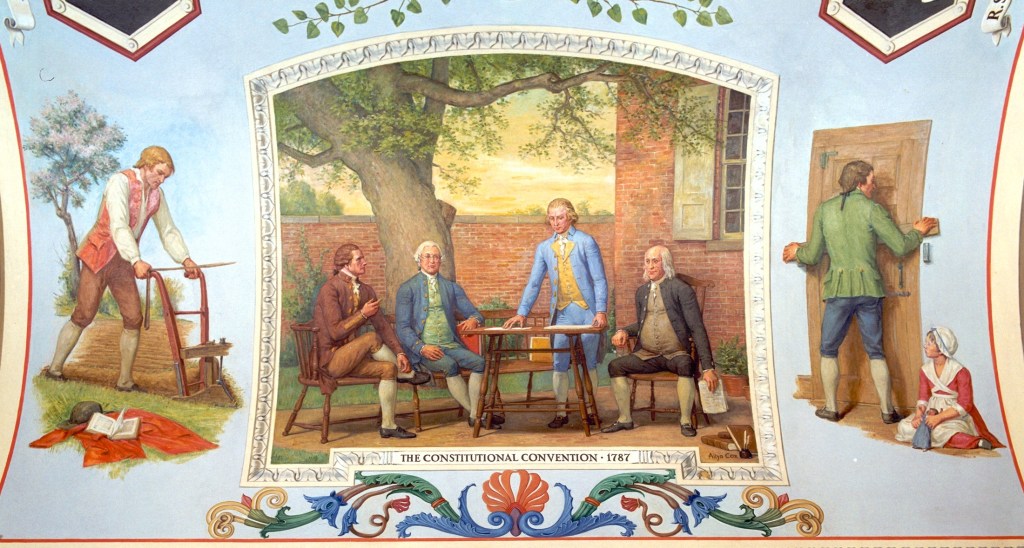
After our nation declared independence in 1776, the task of creating a system of government came about. This task was resolved by the Articles of Confederation, which were passed by the Second Continental Congress in 1777, and ratified by the states in 1781. The Articles created a national government to rule over states that were essentially independent nations. In this system, the federal government was incredibly weak, being unable to collect taxes, enforce its laws, or conduct any of the functions of basic government. By contrast, the states were incredibly strong, and competed with other states and pursued independent policy. Congress was deadlocked, and many states were in financial ruin. By 1787, it was obvious that the Articles needed to either be fixed or replaced, and a Constitutional Convention was held. Although originally intended to revise the Articles of Confederation, the convention quickly changed to forming a new government system. Presided over by George Washington and containing the most prominent men of the early republic, it went through three months of compromise to give us our current Constitution – still in use over 200 years later.
A Tour of the Constitution
The first part of the Constitution – the part with the famous “We the people,” – is called the preamble. It lists several of the basic functions of government; including establishing justice, providing for defense, and securing liberty; and importantly states that the people established the Constitution to achieve these things. The preamble states the tasks the government must accomplish and says that it gets its power from the people.
Article I of the Constitution establishes the legislative branch of the government. It divides Congress into two houses: the Senate (with two representatives per state) and the House of Representatives (with representatives based on population). It lists the powers that Congress holds – importantly the power to raise taxes, declare war, and regulate trade. The Article also gives Congress powers that are derived from the explicitly stated ones. Article I established both the Senate and the House of Representatives.
Article II creates the executive branch, led by the President. It describes the way in which the President would be elected via the Electoral College, a process that would later be changed by the 12th Amendment. Article II makes the President the Commander and Chief and provides the basic powers the position holds. Importantly, it provides a way to have the president removed by the impeachment process. Article II created the position of President.
Article III creates the Supreme Court as the highest court in the land. However, it is very vague about the court’s powers and what role it should play. Both of these things would be decided by the Supreme Court later on. Article III established the Supreme Court as the highest court in the nation.
Article IV requires that different states recognize the laws and decisions made by other states. It also requires states to protect the rights of non-residents and to send criminals from other states to the state they came from. It also sets rules for how new states should be added to the union and forbids the splitting up of states without consent. It guarantees every state a representative form of government and allows the federal government to use the army to put down violence. Article IV establishes rules for how states should behave and be treated.
Article V creates a process for the Constitution to be amended and changed.
Article VI sees the federal government take on prior debts and forbids religious requirements for office. Most importantly, it places the federal government as superior to the states. Article VI states that the Constitution is the supreme law of the land. No law, action, or decision may violate it.
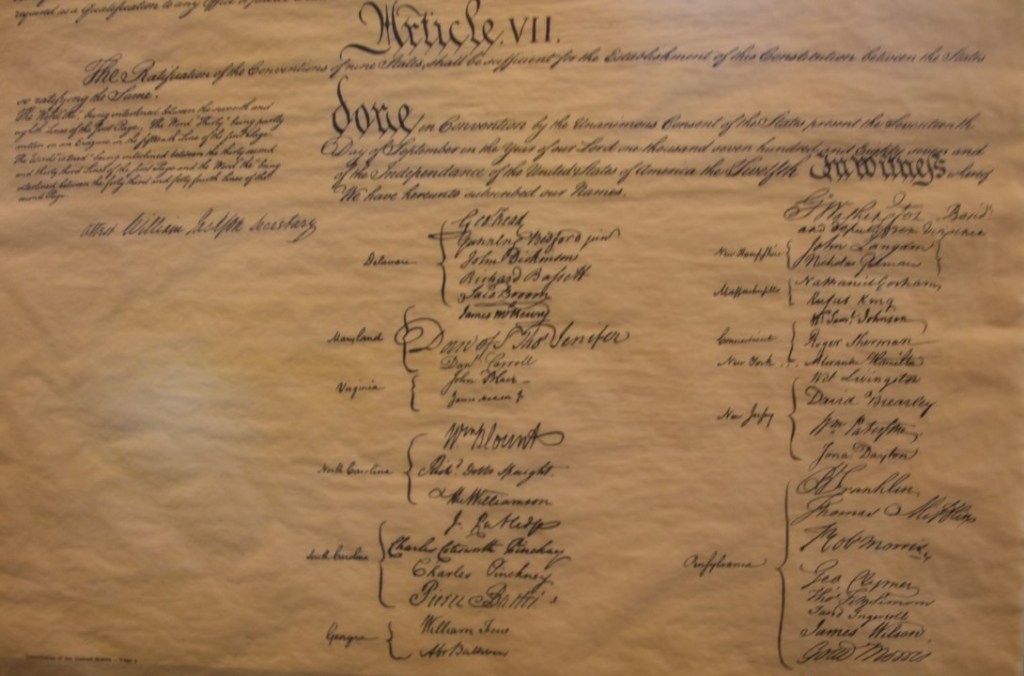
Article VII created rules for how the Constitution would be adopted.
 Melbourne Liberty Bell Museum