
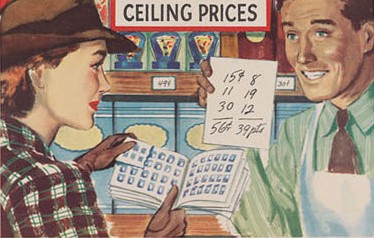
World War II Ration Stamps
This booklet of ration stamps was used by an American civilian during World War II to get food items that were being restricted because of the war.
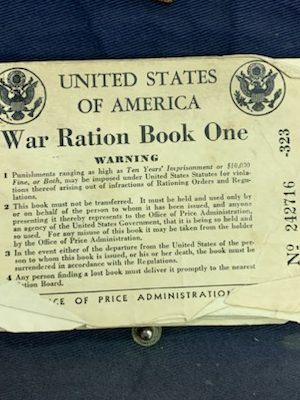
Rationing on the Homefront
With the entry of the United States into World War II in 1941, many everyday items suddenly became scarce. Rubber, metal, meat, chocolate, and other consumer products were prioritized for the armed forces, leaving limited quantities for civilian use. Lower imports decreased the amount of coffee and sugar available. Conscription drained farms of many workers, threatening the food supply. While various programs initiated by the government prevented a collapse of American food supply, there were still shortages. As such, the Office of Price Administration (OPA) oversaw an extensive program of rationing to ensure that the armed forces got the required rations and that civilians had a fair distribution. The first items to be rationed were done so in 1942, with more being added over the years. Most consumer items were no longer rationed by 1945, but sugar remained restricted until 1947. By the end of the war, roughly 100,000 volunteers ran about 5,600 local ration boards. Since food rationing is both the most well-remembered and the subject of the artifact, the way it worked will be covered.
How Food Rationing Worked
Each American family was issued a booklet of ration stamps, with the first being the so-called “Sugar Book” in May of 1942. These ration books contained stamps of different point values, with blue for processed foods and red for meats. When a consumer went to the store, every item had a point value based on its current scarcity. For example, a scarce can of beans might be 14 points, while a more common can of corn could be eight. The point value of different products changed with relative frequency, with changes being announced in newspapers and on the radio. At the register, the buyer would hand over stamps equaling the required number of points and would pay a price set by the national OPA. These too would change rather often, resulting in businesses having to relabel foods on a regular basis. Add to that the fact that there were four different classifications of stores, sorted by business volume, and the fact that stores in groups one and two could charge higher prices than those in three and four, and the result is a confusing, frustrating system that many Americans disliked. As such, some Americans resorted to black market dealers to get their food illegally.
Food Rationing and Americans
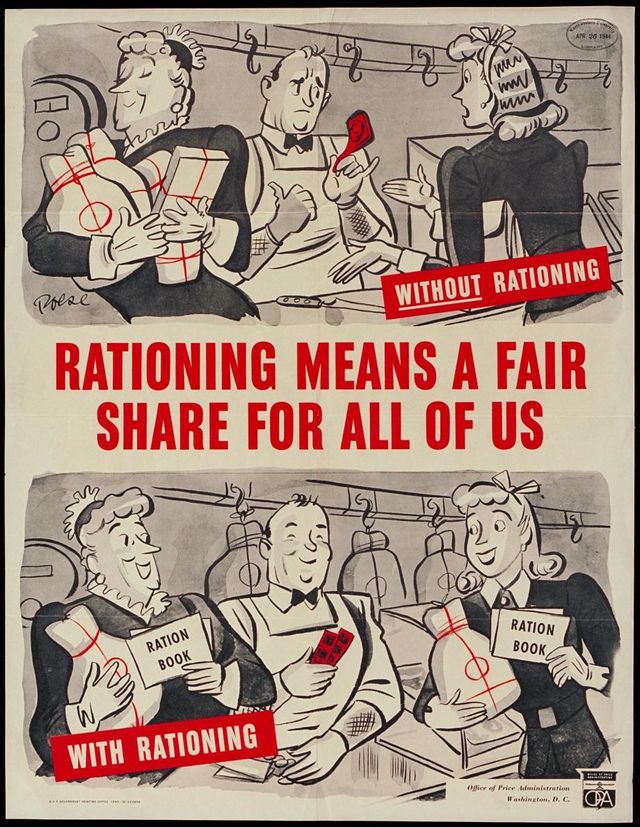
Despite their disdain for the rationing system, Americans recognized the importance of rationing for the war effort. Many people saw rationing as their way to help with the war, and the government went to great lengths to portray obeying rationing as a patriotic duty.
Americans adapted to the shortages of food well, creating new recipes and stretching out the limited resources they had. Some preserved their own food, avoiding having to buy canned food. As produce was not rationed, families bought fresh produce and grew “Victory Gardens” to provide for themselves. The people started to reuse more and make the most out of the food they had.
To this day, food rationing remains one of the most remembered contributions of the Homefront during World War II.

